Moreška
Moreska is pronounced ‘Moreshka’. It means ‘Moorish’. The word is derived from the Spanish adjective ‘Morisco’ or the Italian ‘Moresco’.
It is a matter of conjecture whether the dance came to the Adriatic directly from Spain through roving Spanish sailors, or from Sicily or Italy when Dalmatia formed part of the Venetian Republic whether it was originally a Moorish dance or a Spanish one, inspired by the struggle of Spanish Christians against the Moors is also debatable though the latter seems the most likely.
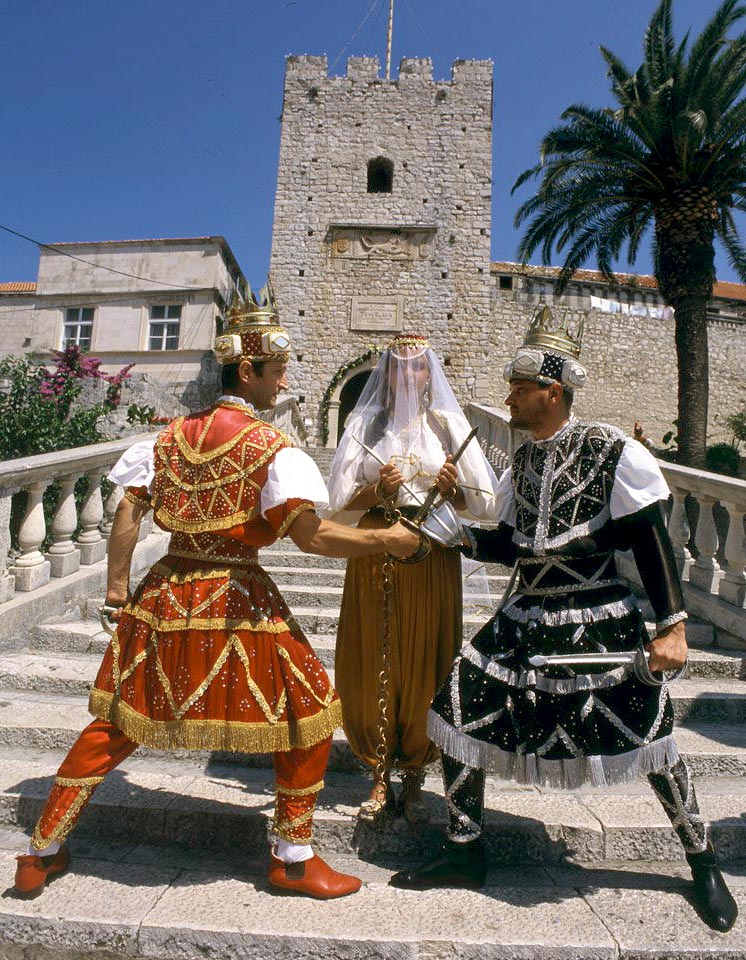
We do know for certain that it is one of the oldest traditional European dances still performed, and that records exist of it being danced in Lerida in 1156 in a form portraying a Christian and National victory over the Moors and their expulsion from Aragon.
From the 12th century and particularly in the 16th and 17th centuries, the dance spread to many Mediterranean countries: to Italy, Corsica, Sicily, Malta, France and, through Spanish trade, to Flanders, Germany and even to England.
It was subject to frequent local variations, in regard to plot, protagonists and eventually also to form. In Corsica it was danced by eighty swordsmen on each side, armed with two swords apiece, who did battle for the town of Mariana to the music of a solo violin; in Elba the engagement was between Christians and Turks, in other places between Arabs and Turks; sometimes the damsel in distress was a white maiden of royal blood, sometimes a Turkish or Moorish one of equal innocence and beauty.
In Ferrara a dragon was introduced who tried to devour the damsel and there were many later versions which degenerated from the original war-dance (intrinsically a useful sword practice and ‘keep-fit’ class for the warriors of small island or coastal garrisons for whom good swordsmanship and alertness meant their survival) into a form of folk drama, and eventually into the dance interludes of pastoral plays and Italian opera.
In Germany the Moreska, though called Moriskentanze, became a mere collection of local folk dances and in England the Morris (l.e. Moorish) dancers threw away their swords and substituted long wooden sticks which they fought with and over which they hopped.
In most of the Mediterranean the Moreska survived until the end of the 18th century, and in Italy and Dalmatia till the close of the 19th.
Popular Routes: Split to Korcula, Korcula to Split, Dubrovnik to Korcula, Korcula to Dubrovnik
Today, Korcula is the only island where it is still danced with real swords in its original War-Dance form and where it has enjoyed a proud and almost unbroken tradition for over four centuries, though the text, music and pattern of the dance have been slightly altered and shortened (the contest used to last for two hours!) over the years.
The introduction to the dance is a short drama in blank verse which sets the scene — four characters recite the verses: the enemy or the Black King, his father, Otmanovic, (a kind of Balkan mediator), the Hero or the White King, and the Bula or Moslem maiden, who is a peace-maker as well as a heroine (and a possible convert to Christianity?).
The Moreska arrived in Korcula in the 16th century, at the same time as it did in Dubrovnik, most probably from Sicily or Southern Italy, via Venice. An indication of this is that two of the dance “figures” have Italian names: the “Rujer” and the “Rujer di fori via”.
“Ruggero” was the name of a Sicilian war-dance, a version of the Moreska, in which the Saracens are shown fighting against the Norman Prince Ruggiero d’Altavilla — a powerful family who ruled over Sicily and Southern Italy in the 11th and 12th centuries, which suggests a possible link.
There are, however, no written records of the Korculan dance until the beginning of the 18th century.
Latterly and up to the first World War the Moreska was “fought” only every few years — protagonists were often wounded and replaced by ‘seconds’ during the dance — between 1918 and 1939 it was performed every year under the aegis of the Gymnastic Society of Korcula.
Nowadays it is an exclusive Society (and ‘club’) of its own and the Moreska is performed much more frequently for the benefit of the many tourists who visit the Island.
Every family in Korcula is proud to have one of its members dance in the Moreska, especially one of the key roles, which demand considerable talent and stamina.
When the Black or the White Kings “retire” they are allowed to keep their crowns and these become valued family possessions.
During the second World war costumes, swords, even musical scores and instruments had all been lost in the bombing and fighting and for the first time in its history only very young lads of between twelve and seventeen were available to dance the Moreska, and they had to be taught from scratch.
It was the undefeatable and indefatigable spirit of Ivo Lozica, the town barber, and Bozo Jerirevic, a school-teacher, with the help of a local policeman, Zdravko Stanic, and Josip Svoboda the conductor of the town orchestra, that somehow got the Moreska dancing again and in a very short time the poor, thin undernourished youths were growing into splendid young men and were taking the Moreska to youth conferences and festivals at home and abroad.
THE MORESKA DANCE
- The Cast
- The Bula (The Moslem Maiden)
- Moro, the Black King
- Osman, the White King
- Otmanovic, the Black King’s father
- The Moreska Brass Band
The revised score of the Moreska was composed by Krsto Odak who, working with Josip Svoboda, conductor of the town orchestra at the time, reconstructed an earlier score lost in the war.
The Moreska from Korcula opens with a scene in which the Black King is seen dragging the captured Bula (Moslem maiden) along in chains trying to persuade her to respond to his love. The Bula refuses because she loves the White King and knows that he loves her.
The White King and his army and the Black King’s army with banners and swords enter from either side. The two Kings confront each other and a dialogue of hurled insults and scorn ensues.
The Kings are the first to cross swords while their armies stand facing each other and ready for battle. When the White King calls on his men to fight, the two armies clash swords and then break away from one another in order to make way for the Dance of the Black King, the graceful but menacing ‘Sfida’. In this dance, which is performed in 6/8 rhythm, the Black King challenges the White King to a contest.
The White King accepts the challenge, and then the Black King’s father, Otmanovic and a soldier from the White King’s army join the fight. They dance in a circle threatening one another with swords.
The soldier withdraws leaving the two Kings and Otmanovic. At a given moment both armies, who are facing each other, leap forward and clash swords and then the Black King, still dancing, forms a circle with all the soldiers of both armies gradually joining in.
After this, seven Kolaps or “strokes” of the Moreska are danced in different and complicated rhythms and patterns and all are performed within this circle. The fight consists of alternating sword thrusts and parries. It is performed in pairs, i.e. one White against one Black fighter.
The seventh Kolap is performed in a speedy 4/4 rhythm and the swords clashes are fast and furious. The Black soldiers, facing outwards, defend themselves from within the circle which becomes smaller and tighter as they withdraw from the charges of the White army.
Finally the Black soldiers fall down wounded, dying and defeated, laying their swords at their enemy’s feet. The Black King admits defeat and surrenders, the White King, the Victor, frees the Bula from her chains and kisses her.
The following dialogue is translated from pat of the 19th century Croatian text of The Moreska published in Zadar in 1869.
Bula: Leave me alone! Your demands are in vain
My charms belong to another man.
Sweet Osman, my beloved,
If you could see now
How my heart is breaking
And full of sorrow for you!
Although this odious steel
Binds my hands,
My heart is always with you
And yours with me.
I shall bear you in my heart
As long as I have life.
Moro: Stop wailing, my lady
I have had enough!
It is painful for me to listen
When you call my opponent your pride
Here, in front of my face
But I bear and endure it all
For the love I feel for you
My dear nymph, I give you my heart
For your sweet charms.
Bula: If you will
But one favour grant me,
All I ask
Is that you stop loving me.
Of far more pain for me
Is your unwanted love
Than the steel
That weighs upon my hands.
Moro: I will not leave you
Nor will I stop loving you.
I love honorably your everlasting beauty.
Ask whatever you wish,
Even my father’s kingdom.
        Drums are heard.
        Enter the White Army.
Otmanovic: There is no fear in Otmanovic!
Osman: Do not trust your sword
Without honour and without honesty.
Treacherously, you wished to steal
My betrothed, by torturing her.
Where is your knightly honesty,
Where your bravery?
How did you dare to enslave her?
Let me remind you
That the army from my court
Is ready to rescue her.
Moro: You ask me to return her
To your hands. Never!
I would rather lose my head.
Bula: Ah, you wicked man!
Osman: If it were not that I disdain
To darken my sword with your blood,
And stoop from my might,
I should destroy you.
Otmanovic: Useless to be angry, Osman,
Listen to me.
There is no difference
Between your two crowns,
Both are full of glory
I am an emperor as you are!
Osman: How dare you compare
My crown with yours
Me, who reign over all the world,
From East to West, and fear nobody.
Moro: Ah! I cannot bear
Your offenses any more.
Fall then!
Osman: Now defend, come my army.
Bula: From this sharp sword I will willingly receive
The wound of death;
Come, deadly steel
If it will stop their mutual rage.
Moro: Console yourself, dear Nymph,
I could not bear to look
At your dead body in my lap.
Now, knight, gather your armour.
A fierce war is about to begin.
Bula: Then render me to him
I my death would afflict you.
My affliction is the greatest
Because I would rather choose death
Than your unwanted love.
Osman: To your arms, my soldiers,
Let everyone be witness to my honesty,
Which is as big as my empire.
Now, knight, gather your armour.
A fierce war is about to begin.
Moro: Willingly, oh knight,
I shall be fighting for the nymph.
**Together
I am ready to fight for the damsel
Who arouses my love and noble passion;
Willingly, oh knight.
**At the end of the 4th Kolap
Bula: Oh, knights!
Do something to stop your wars
Which wound my heart and draw tears of
Blood from my eyes.
Turn your sword on me
And let him live
Take my life
But my beloved spare.
Moro: As long as I have
Power in my hands
I will cause him strife
Rather than lose you.
Osman: You are going to lose
Either by defeat or by slavery.
My strength and courage
Will force you to relinquish her to me.
**At the end of the 7th Kolap
Osman: You’ve lost all your dignity
And now you are my slave for good.
Moro: I readily to you my sword surrender
It has grown heavy in my hands.
And with it I return your Bula.
Bula: My dear, sweet love,
For whom my heart is longing,
Receive the gift of my eternal faith,
Take me, your constant love.
Osman: Let this chaste kiss
Be a reward for all my suffering.
Moreška – korčulanska svetinja
Korčulani su Morešku upoznali prije gotovo 400 godina, točnije početkom 17. stoljeća. Teško je reći odakle je moreška stigla u Korčulu. Najstarija poznata moreška izvedena je 1150. godine u Španjolskoj, a različiti plesovi s mačevima šire se po cijeloj Europi do kraja 14. stoljeća.
Prvi podaci o moreški na našim prostorima datiraju it 1273. godine u Trogiru. Moreška je vjerojatno došla u Korčulu preko Dubrovnika iz Španjolske, jer su u 15. stoljeću postojale jake veze između Dubrovačke Republike i Španjolske.
Da su Dubrovčani poznavali morešku svjedoče djela poznatih dubrovačkih pisaca Marina Držića i Điva Palmotića. Dok je za Europu bila “modni hit” Korčulane je toliko zaokupila daje u stoljećima koja slijede, postala nerazdvojni dio njihova življenja i običaja.
Tako je u svijetu proživljena i zaboravljena svoje trajno utočište i ljubomornog čuvara našla u Korčuli i Korčulanima.
Što je uopće moreška?
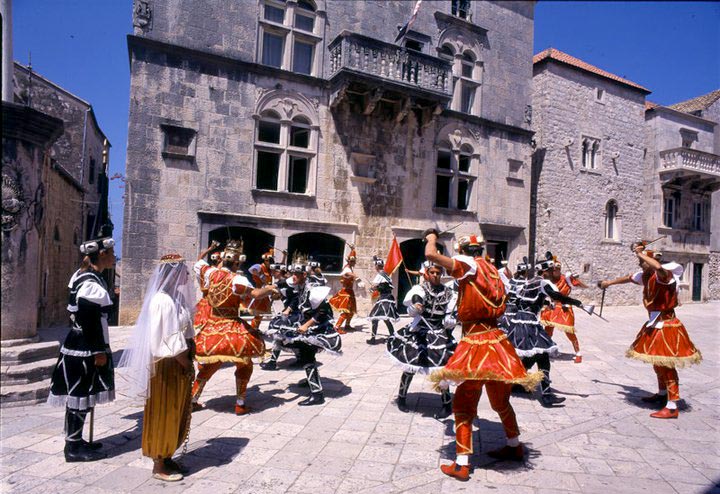
Korčulanska viteška igra moreška je bojni ples s mačevima kojeg karakterizira kratka dramska radnja. Moro, sin crnog arapskog cara Otmanovića oteo je bijelom kralju Osmanu zaručnicu – bulu.
Bula Moru ne uzvraća ljubav. Osman dolazi sa svojom vojskom vratiti zaručnicu, ali ga dočekuje Moro spreman za boj. Kraljevi se nakon prepirke dogovore da će viteškim bojem izvojevati djevojku.
Borba se sastoji od sedam različitih mačevalačkih figure kojima prethodi Sfida – izazov, vjerojatno najstarija figura moreške. U posljednjoj figuri crmi bivaju potučeni i Moro predaje bijelom kralju u znak pokornosti svoje oružje i bulu.
I dok povijest bilježi morešku kao reminiscenciju pobjede Spanjolaca kršćana nad Arapima – Maurima, danas ona simbolizira pobjedu ljubavi i dobra nad zlim.
Obzirom da je kroz povijest glazba izgubila svoju autentičnost i doživljavala mnoge izmjene, posljednjih pedesetak godina moreška se izvodi na komponiranu glazbu poznatog hrvatskog skladatelja Krsta Odaka, koja svojom kvalitetom moreški daje dodatni efekat.
Kostimi moreške
Kostimi moreške jedan su od bitnih elemenata igre. Kontrast crvenih i cmih kostima u plesu i mačevanju upotpunjuju ukupni dojam o samoj igri. Najstariji kostimi korčulanske moreške nisu sačuvani, a ni u opisima mačevalačkih igara se ne spominju, ali suknjasti izgled današnjih kostima čini razumljivu sličnost i asocijaciju na srednjevjekovne ratničke kostime.
Moreška se stoljećima u Korčuli “bati” u dane blagdana i važnijih događaja. Korčulani su imali čast ugostiti i “batiti” morešku pred austrijskim carem Franjom Josipom i engleskim princom Eduardom. Najvažniji godišnji nastup je 29. srpnja dan Sv. Todora suzaštitnika grada. Tom prigodom morešku igraju najbolji korčulanski moreškanti.
Posljednjih desetljeća moreška je nezaobilazni dio turističke ponude i najprepoznatljivilji turistički proizvod grada Korčule. Turisti je mogu dozivjeti u izvornom ambijentu korčulanskih kula i zidina u večernjim satima 1 – 2 puta tjedno. Tada se glazba, šarenilo kostima, iskre mačeva i sjaj baklji sa živom kulisom zidina Korčule stope ujedno. U Korčulu treba doći i proživjeti taj ugođaj.
Naravno, moreška je gost i mnogih turističkih sajmova širom Hrvatske i Europe. Tako su morešku upoznali i zavoljeli mnogi ljudi izvan Korčule. Korčulani su morešku “batili” u Parizu, mnogim gradovima širom Velike Britanije, od Glazgova do Lšondona, Essenu, Frankfurtu, Bernu, Pragu, Brnu, Bratislavi, Berlinu, Oslu, Malmoe, Kopenhagenu.
U Stockholmu se 1976. godine moreška igrala u dvorani u kojoj se dodjeljuju Nobelove nagrade. Moreška je godinama bila gost Venecijanskog karnevala gdje su Korčulani igrali morešku na trgu Sv. Marka, na istom onom trgu kojim je prije sedam stoljeća šetao i korčulanin Marko Polo. 1996. godine Korčulani su morešku odigrali i u njenoj postojbini Španjolskoj i tako podsjetili španjolce na davno zaboravljenu igru s mačevima.
Korčulani su ponosni na morešku, prenose je s koljena na koljeno, s oca na sina, a jedno od najznačajnijih obilježja svakog korčulanina je biti moreškant. Korčulanski dječaci gotovo pobožno godinama “upijaju” svaki korak, svaki udarac mača, dok ne postanu spremni nasliljediti svoje očeve.
Posebna je čast i privilegija biti najbolji od najboljih – biti jedan od kraljeva.
S toga je moršeka za Korčulane više od same mačevalačke igre, ona je dio života, o njoj se priča u svakoj korčulanskoj obitelji. I tako s ponosom možemo zaključiti da je četiristogodišnja tradicija dovoljna garancija da će Korčulani znati sačuvati svoju morešku.
Tekst pripremio: Mato Divić