History of Korcula Island
Prehistory
The island of Korcula and the peninsula of Peljesac were inhabited even in the Neolithic Age, i.e. six to eight thousand years ago. There are numerous archaeological findings from that time, ranging from the first settlements, caves, tumili, and old stone buildings (gradine) to the earliest tools such as stone axes, pieces of ceramics and flint knives. The most important localities dating from that time are Vela Spilja (Big Cave) near Vela Luka, Gudnja and Spila on Peljesac, and Jakasova spilja (Jakas’s Cave) near Zrnovo. There are also numerous tumuli and stone buildings, the earliest types of fortified settlements, using natural unworked stone; they are most often situated on peaks and hills, providing a good view and difficult access for the possible invader. It would appear that the whole territory of Korcula and Peljesac was parcelled out according to zones of interest.
Even today the inquisitive visitor can find numerous fragments of ceramic products at various localities which are often called an old town. These are the last remnants of the prehistory of this region. The most important gradine are near Smokvica, Vela Luka, Zrnovo, Pupnat, Donje Blato and Potirna on the island of Korcula, and Grad near Nakovanj, Gradac, Humac, Gradina, Crkovna Glava and Velike Stine on the peninsula of Peljesac.
Grad near Nakovanj, on the way to Loviste, can be easily visited as it is near the road. A natural large stone rock tops this hill and dominates the whole valley. The prehistoric men knew how to organize life on this plain of roch – they dug out holes for gathering rainwater cutout stairs on the Southside where access was not easy in order to enlarge the surface and make the fortification more secure. They built massive supporting walls in dry stone. Unfortunately, the complete forms of these settlements can only be guessed at.
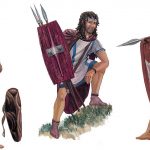
The first known inhabitants of these settlements in the Korcula and Peljesac region were Illyrians, as they were later called by the Greeks and Romans. They were united in tribes, were ethnically quite homogenous and occupied quite a large area, living from agriculture and cattle breeding.
Hellenic Korcula
Greek colonization was rather sporadic. The Greeks did not come as conquerors but looked for a modus vivendi, making no attempt to assimilate the Illyrians, who were thus able to continue their tribal life. The Greek colony lived for centuries parallel to and separate from the large Illyrian territory, having no special influence.
In the VIth century B.C., Greeks came from the small Asian town of Knidos during the first big Greek colonization of Sicily, South Italy and the Adriatic, when Great Greece (Magna Grecia) was created. The historians Pseudo-Skymos, in the IIIrd century B.C., and Pliny the Elder mentions the colonists from Knidos who founded their settlements on Korcula. Pliny the Elder mentions that ancient town in his work “About Nature”: “The distance from Issa to what is called Black Korkyra, with its Knidian town, is 25 miles…” There is also a legend, recorded almost two thousand years, ago, that the town of Korcula was founded by Antenor, a Trojan warrior, who fled to Korcula after the fall of Troy. The XVIth century stone plaque at the Western entrance to the town mentions Antenor as the founder of Korcula. This legend is also described by the writer Dihtys in his work about the Trojan Wars, which he based on the Greek original from the Ist century; he says that Trojan fugitives, led by Antenor, founded the town. The stone town of Korcula was also incorporated into old Greek mythology; according to Apolonio from Rhodos, Poseidon ordered Ezop’s daughter Kerkyra, to settle here, and when the Argonauts were passing by Korcula and saw the dense wood cover, they called the island Black Kerkyra.
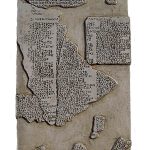
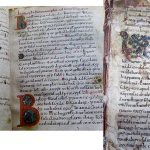
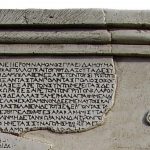
Proof that the Greeks were the first colonists on Korcula is provided by an extremely valuable document, a psephism from Lumbarda of the IVth century B.C. This stone tablet, written in Greek. concerns the Issa families, Greeks from the island of Vis, who came to the island and how they planned the city and the land for use. The text of unambiguous about the existence of the town: “During the time of Hijescomnamon Praksidan, in the Mahanej month, the contract about the founding of the settlement was drawn up between the people from Issa and Pil and his son Diaz. The founders agreed and the people decided: that those who first took the land and walled the town get special sites for building inside the fortified town … that the authorities swear that the town and the land will never again be divided .. .”
The text ends with 200 names of Greek families. This is tile oldest written document found on the territory of Croatia.
There was a great disparity between the way of life of the Greeks, with their urban culture and social organization, and that of the Illyrians, who had preserved their ancient ways. Therefore, not even a hundred years later, Korcula became the seat of Illyrian pirates. The Romans attacked Korcula, Lastovo, Mljet, Peljesac and the Neretva area during their crusades to extend their empire. The repeated clashes with the Romans came to a climax in the Ist century which proved fatal for the inhabitants of this region, who had for so long been unconquered; Emperor Augustus, in his crusade against Korcula, exterminated almost all its people. The warriors were killed and the rest were either moved or sold as slaves. This initiated a strong Roman influence on the island. That was the time of great ascent of Rome, its great military successes, the expansion of the empire throughout the whole of the Mediterranean and the creation of Roman provinces. Korcula found itself in the provinces of Dalmatia, and this immediately led to the organized immigration of Roman citizens, more progressive exploitation of the land, and the building of numerous villas, Thus the area was Romanized. Villas appeared throughout the territory of Korcula and Peljesac.
Popular Routes: Split to Korcula, Korcula to Split, Dubrovnik to Korcula, Korcula to Dubrovnik
Early Middle Ages
The Western Roman Empire finally disintegrated In 476 due to, among other reasons, the constant pressure of militant groups which, although the Vth and VIth centuries ravage tile territory of the vast empire, a part of which was Dalmatia. After a short period under Goths (Teodorik), Korcula, together with coastal Dalmatia, came under the rule of the Byzantine empire. Little remains from that period, but Byzantine coins are found, and there are numerous churches dating from the late Hellenic and early Christian period on the islets of the Korcula archipelago: Sutvara, Majsan, Lucnjak, Gubavac.
The Croats came to the Adriatic coast in the VIIth century, in the course of the great migration of peoples. They came to get her with other groupings of Slavs and Avars. As is natural, the islands were populated somewhat later, the first tribes from the Neretva valley settling down in Korcula, Brac, Hvar, Mljet and Vis in the IXth century.
Its exceptionally favorable position in the middle of the Adriatic and on the important trade route enabled the Neretva tribes to constantly endanger navigation and the sea trade. This trade was becoming more and more intensive due to the strengthening of Venice. But the principality of Neretva became so strong that Venice for some time had to pay a tribute for free naval passage in this part of the Adriatic.
The “economic” activity of the Neretva tribes consisted, to a great extent, of piracy. Their domination of the seas of central Dalmatia was primarily due to the ideal disposition of the islands, their control of the critical points of this maritime route, and the prowess of these militant and experienced Neretva seamen.
One of these critical points was the island of Korcula, lying in the channel which was called by its name. Perhaps this is what so attracted Konstantin Porfirogenet, the Xth century Byzantine emperor, who devoted great efforts to consolidate his empire, and was also known as a great historian and travel writer: “Four islands lie nearby: Mljet, Korcula, Hvar, Brac, very beautiful and fertile with many deserted towns and meadows; the inhabitants live from cattle raising… They have in their power these islands: Korcula or Krkar, on which there is a town.”
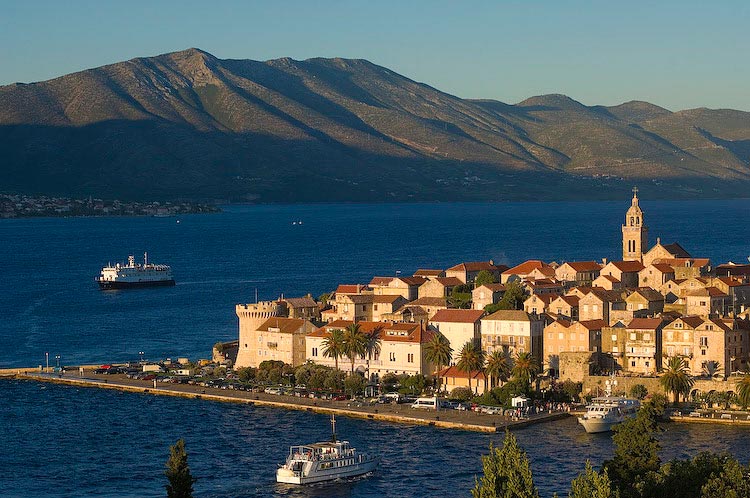
It is most probable that this town was situated on today’s site because it dominates the important strategical point over which the Neretva tribes had power and control. This fortified settlement and maritime passage became the battlefield for the struggle with the Venetians in the year 1000. The Venetian duke Peter II Orseolo came with his military fleet in front of Korcula, anchored near the islet of Majsan, conquering it and the island of Lastovo. He waited here for the representatives of Dubrovnik to pay him tribute.
The Venetian Period
This was, however, a rare appearance of Venice in the East Adriatic for it was not strong enough at that time to be able to defend its sovereignty over the Adriatic. Venice would do this much later in the XIII century, after she had resolved her relations with the rival towns of Pisa, Rome and later Geneva, which also envisaged fertile trade relations with the East.
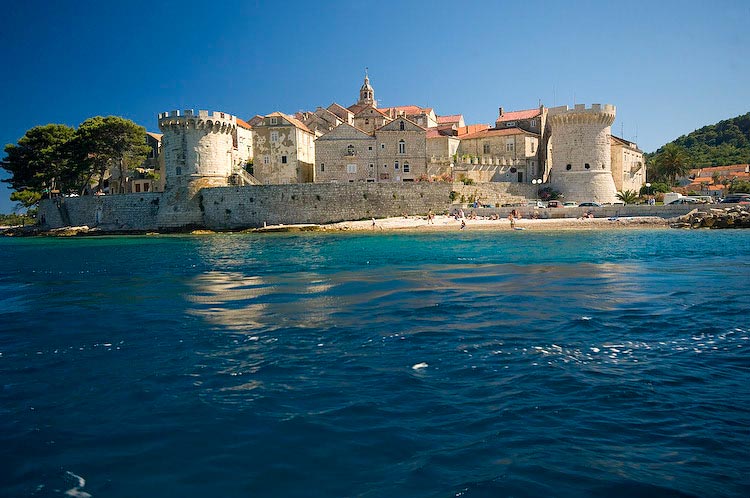
In the meantime, Korcula changed its rulers: first Zuhumlje, then Croatian-Hungarian states, and, at the beginning of the XIII century, Dubrovnik. All these changes in government, through which Korcula never lost its own citizenship, are coloured by the fact that Korcula was far from being one of the main preoccupations of the Byzantine empire, as its real problems lay on other borders. Venice similarly could strengthen her influence only with a large military expedition. Thus the Korculans expelled the duke Marsilie Zorzi in 1256, only two years after he had taken power, but recognized him again when he returned to the island with armed galleys. The struggle of the island community with the masters of the island is a permanent characteristic of the Middle Ages.
However, the princes of the Zorzi family won the hereditary right to govern Korcula, but according to written rules i. e. according to the written “Statute of the town and the island of Korcula” of 1214. The Korcula statute is a very important historical source which reveals and explains a great part of Korcula’s cultural and economic history over a long period, up to the XVIth century. But the statute is more than that – it is a picture of the constant effort of the inhabitants to maintain the independence of the island and the town in spite of foreign rule, to make official the forms of liberty, and to consolidate their rights. When Marsilie Zorzi was chosen as the hereditary prince of the Korcula and Mljet principalities, the inhabitants of Korcula did so of their own free will defining his salary, confirming his lands and demanding that he ruled according to the mutually confirmed statute.
Venetian power and influence in the Adriatic grew thanks to enormous trade, great accumulations of capital, a strong naval fleet, and extremely subtle or arrogant diplomacy depending on the circumstances. Its relations with the rival city of Genoa greatly occupied Venice. When diplomatic relations came to a crisis, a great clash occurred between these two Mediterranean powers.
This clash took place in the waters of Korcula in 1298. 180 galleys took part in this great naval battle. Genoa won, but losses were great on both sides. The commander of the Venetian fleet, Andrija Dandolo, was killed and many other famous Venetian captains were imprisoned. No less a man than the world traveller, the first explorer of the Far East, Marco Polo, was imprisoned, defending his Venetian Korcula in this battle. During his year of imprisonment, he narrated the events of his fantastic journeys all over the Far East to his fellow prisoner, the scribe Rusticiano of Pisa, who recorded them. So the famous Marco Polo travel book was written, which aroused great interest in Europe and still does even today. Korculans are proud of the real possibility that Marko Polo was born a Korculan.
The princes of the Zorzi family maintained their position in Korcula up to the middle of the XIVth century. Then Korcula came for a short time under the rule of Hungarian-Croatian kings, Ludovik and his successors, who wanted to make the islands of Hvar, Brac and Korcula the center of their naval force. At the very beginning of the XVth century, Ladislav Napuljski ruled Korcula for a short time.
The year 1420 was decisive. In that year, Venice gained domination of Korcula for the fourth time, together with the greater part of Dalmatia. From then up to the Napoleonian wars and the fall of the Venetian Republic in 1797, Venice dominated Korcula, this last time for 370 years, via 149 princes.
In the XVth century, Europe was threatened by a new aggressive power from the East – the Turks. Their penetration into the Balkans was gradual but relentless. They conquered Belgrade at the beginning of the XVI century and, after the battle on Mohac, they even came to Sisak, Siget and Klis forming a fatal geographical wedge in our territories. The political map of the Balkans was changed radically, and Turkish destruction and pressure were the real threat and danger for the whole of Europe for many years.
Korcula was only marginally involved in these great changes and even, in the XVth and XVIth centuries, experienced its greatest period of prosperity. Directed by the will of Venice to relations exclusively inside Serenissima, it managed to create its own prosperity and achieve a stable development from these long-range economic and political relations. Korcula was at its height, unequalled before or since.
The Defense of Korcula from the Ottomans
Although Turkish pressure existed, it was much less evident on the sea than on land. However, the neighboring Dubrovnik (getting there), and Venice especially, had numerous clashes with the Turks (the Candi wars). At the end of the XVIth century, in 1571 to be precise, Korcula witnessed the great battle between the Turks and the united forces of Venice, Spain and the papal state, known as the battle of Lepanto. One part of the ships, immediately before the clash, left for the Adriatic towards Hvar and cochlea, led by the Algerian vice-king Uluz-Ali and Karakozi, the commander of Valona.
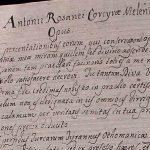
An authentic text by a participant in this siege, the archdeacon Rozanovic, who also commanded the defence of the town, has been preserved. Korcula experienced dramatic moments during the siege. Rumours about Turkish ships came on August 2 from refuges from Epir and Ulcinj, and on August 15, thirteen days later, the Turkish galleys appeared.
“Galleys, helped by the force of the wind and driven on by the strength of the rowers, quickly sailed below the city walls within the reach of our guns. Then the sign was given by the ringing of the bells, as had been agreed before. The fight began with great shouts from our men, who encouraged each other and then started to shoot and strike the enemy from the walls with all kinds of arms.
Some of the enemies cried out that they were Christians so that we could hear them and, indeed, they had in front of them flags bearing crosses. But when they saw how we were showering them with fire from cannons and other arms, creaming and wild shrieks could immediately be heard. Then small enemy bullets echoed from the walls and the roofs of the houses, like the sound of hail, and it rained arrows. We noticed that they ran towards the stern before they shot, so the prow would leap up and the bullet would rise above the roofs of the houses and the church and tower… The fighting lasted for two hours. Everybody in the town seemed to undergo a change. Courage had returned … Everybody was busy either in fighting or in helping the fighters.”
The Turks, unable to approach the walls from the sea because of the guns, disembarked on the land, some thousand of them “under three flags”. They first went to the Prince’s Palace. The struggle was fierce, some of the defenders were hit, and the walls were giving way under the blows of the enormous iron shells. The situation was quite uncertain. But then came a miracle! Rozanovic narrates further:
“Suddenly a North wind started to blow with a ferocity hardly ever seen even during winter. It started to drive the enemy’s ships towards the city walls. The enemy was frightened lest their galleys be broken against the sea-rocks and destroyed by our arms. The rowers had to use their utmost efforts to move from the city walls; they overcame with great pain the horror of the wind and the sea waves and sailed to a bay behind the monastery of Sveti Nikola on boats which were struck, first by our blows and later by the sea and the storm … Of the 20 galleys and half galleys, not even one escaped some damage.., some had broken masts and gaffs, some were without the rostrum, some had damaged ribs and some had a broken stern. Ten of them were disabled and had to be pulled by ropes. We learned from the deserters that 180 Turks were killed and as many slaves…
After that, these ships sailed to the village of Lumbarda where our summer houses were. Here they met about 1500 people who had disembarked the night before in the bay of Brijaca (Racisca). They slept calmly by the coast all night and at dawn, they crawled in all directions over the island, starting from its first half and moving towards the east edge, searching every hedge, mountain valley, hill and cave, imprisoning 34 peasants of both sexes who could not hide inside the walls. They seized a big booty of cattle and they killed and left in woods what they could not drag behind, giving the food to crows and hawks. They became completely crazed in Lumbarda. After carousing in the courtyards, they devastated them by fire.
We finally saw a boat with speedy rowers and sails near Mljet sailing towards our island, and we also saw Karakozi’s boat sailing towards it. When they joined they returned to the others, and, when they arrived, they all sailed away. We concluded immediately that the order came from the commander of the Turkish ships for Karakozie to hurry up to join the other ships.”
So the Archdeacon Rozanovic’s narration of the battle with the Turkish armada ended. It is evident that this event deeply moved the Korculans. Even today, the “Moreska” dance reminds the inhibitions of Korcula of these heroic days.
XVII & XVIII century
Existing on the border territory of the Venetian Republic, Korcula lived with Turkish danger in front of the doors of their city and island, in the XVII. century. This was during the period of the Candian War (1645 – 69) and the Morean War (1684 1699). Some of the Korculan patricians had actively participated in these battles between the Christian and Islamic world, and were under the very command of the Venetian war fleet. In this way, for instance, Jakov Arneri distinguished himself in the service of the Venetian Admiral Leonard Foscolo, in whose honour the Korculans raised a stone arch of triumph/tower on the very entrance into the city. The Arneri family placed his statue in the courtyard of their palace.
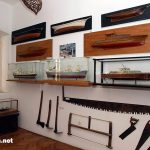
During the XVII and XVIII centuries, Korcula did not repeat its heights in building workmanship from the previous two centuries, but instead continually developed to a greater extent its shipbuilding activity. Hence in 1823, the first shipbuilder cooperative society under the name of BANCA DI SAN GIUSEPPE was founded. The Venetians, for reasons of concurrence, by the decree from 1669, prohibited Korcula from building larger ships. However, the craftsmanship of the Korculan shipbuilders could not be totally ignored, so that later, they themselves constructed and repaired their ships in the Korcula shipyards. An important event for the economic life of Korcula took place in 1776 when the Venetians transferred their famous arsenal from Hvar to Korcula. As a result of this, it became the main naval stronghold and army shipyard on the eastern coast of the Adriatic. In Korcula, warships with from 20 to 40 cannons of the “nave gregata” and “vascello” type were built.
On the other side of the Peljesac Channel, one other Republic Dubrovnik, protected its interests and defended its territory from the Turks as well as from the Venetian Republic. In spite of the administrative prohibitions which existed on both sides, as well as the conflicts, the connections between this part of Peljesac and Korcula in this time had multiplied, especially in seamanship and shipbuilding. The sea and the ever-passable sea route through this strait meant the true joining of these two shores, today’s unique tourist region.
Its first nucleus actually started to form when in the XVIII. century in Orebic, Kuciste, and Viganj, houses started to sprout along the very seashore, after piracy had lost its meaning. In this way, this region of the Peljesac Channel, along with its building effect, completed and created a unique natural and building spirit on both shores of this region. This was recorded by Venetian travelling writers and reporters who had called it “the most beautiful Channel”.
At the end of the XVIII. century, with the Peace Treaty of Campoformio in 1797, Venice lost its dominance on the Adriatic, submitting to the war strokes of Napoleon.
In this way, a new era had started for this Korcula-Peljesac region, which will formally include them in a mutual state administrative entirety.
XIXth century
This stormy period in the European history, which began with the French revolution, could not leave Korcula and its surroundings unaffected, as had basically been the case during the Turkish reign of terror over all the Balkan peninsula. After the fall of the Venetian Republic in 1797, Korcula came under the power of Austria, but this reign quickly ended by the Peace of Pozun in 1805. Napoleon’s army took Korcula together with the whole of Dalmatia, in 1806. That was the time of the war between Russia and Prussia on one side and Napoleonic France on the other. The strategic position of Korcula played its role again. The Russian fleet sailed into the Adriatic and shot from its cannons at the town of Korcula in April 1806, forcing the French to retreat within two days.
Less than a month later the French cunningly disembarked in the strategically placed cove of Racisce and seized the town of Korcula without a fight. But two days later, two big Russian ships and one frigate forced the sparse French force to flee. After a few months, the French entered the town again with an army of 900 soldiers and many ships. The Russians, together with the Montenegrins, took the town again after a battle. After the Peace of Tilzit, the Russians handed Korcula over to the French, who remained here until February 1813, when British troops, as victors over Napoleon, entered Korcula, keeping it in their power until 1815.
This short period of British rule under the command of Peter Lowen left an important mark on the island; the new stone West quay was built, as well as a semi-circular paved terrace with stone benches on the newly built road towards Lumbarda, and a circular tower, “forteca” on the hill of Sveti Vlaho. This fortress completely dominated the channel and was to play an important role in the history of Korcula as a perfect watchtower and a fortification. According to the terms of the Congress of Vienna, the British left the island of Korcula to the Austrians in 1815 on July 19.
Austrian rule and the Austro-Hungarian rule which followed lasted for more than a century and were typified by the motto of the world powers of that time: Divide et impera (Divide and rule). The Austrian policy of denationalizing the Dalmatian coasts and favouring the immigrant Italian minority left its mark in the political division of the population as best expressed in the political parties: the People’s Party and the Autonomous Party.
This political division also had its roots in class, as the greater part of the autonomous party, which wanted Dalmatian autonomy in the frame of Austria and was against joining the other parts of Croatia, as wanted by the People’s Party, belonged to the richer strata of officials and administrators.
Agriculture could not offer an easy existence to the peasants, who were subjugated into a semifeudal relationship with a few rich patrician landowners. The undeveloped trade and the customs barriers signed by Austria hindered the sale of agricultural products to other countries. If we also consider the stagnation of the traditional Korcula occupations, fishing and stone-cutting, then it becomes even more evident that the alien reign could not bring prosperity to Korcula and its inhabitants.
Only shipbuilding and navigation continued somewhat more successfully due to the great ingenuity of the Korcula masters and the Peljesac captains and seamen, who cooperated with each other.
An important political change occurred in 1870 when the People’s Party won the majority in the Dalmatian parliament (Sabor). This was helped by the changed political climate after the victory of the Austro-Hungarian navy over the Italian fleet near Vis, in which many people from Korcula and Peljesac took part. The mayor of the first Croatian community in the town of Korcula, the popular leader of the People’s Party, Rafo Ameri, greeted Emperor Francis Joseph in Croatian in Korcula in 1875.
The Korcula shipyards and the “Peljesac Maritime Society” in Orebic, founded in 1865 on the modern principles of the shareholding society, were spreading the fame of the Korcula-Orebic shipbuilding and sailing tradition over all seas and oceans.
Revolutionary technical changes left Korcula and all Dalmatia on the margins of industrial development. Moreover, plant pests, especially Peronospora, which came from America, devastated the vineyards. But the tough and persistent inhabitants of Korcula and Peljesac started to restore the vineyards.
After the removal of the clause limiting export limit in the Austrian-Italian trade agreement in 1902, Korcula wine, especially that from Vela Luka, began to be exported successfully and at a very good price.
XXth Century
A new economic activity – tourism – started in Korcula and Orebic at the very beginning of the XXth century. New societies for “embellishing the town and its surroundings”, first in Orebic and then in Korcula, organized the planting of parks and new ways of using public properties. A small shipping line was founded as well. The first modern hotel, the “De la Ville”, was built in 1912 on the Western quay so that it first struck the eyes of the tourists coming by ships, which were rather luxurious for these days, from Venice, Trieste, and Rijeka. Public bathing places were put in order, and the first tourist, guide of Korcula was published in a few foreign languages in 1914.
However, this relative prosperity was soon disturbed by events on the world scene. The first World War and later events on the World scene brought not only great loss of human lives but also economic catastrophe to the inhabitants of Peljesac and Korcula, many of whom were forced to emigrate, especially to both Americas.
More history articles:
-

Lumbarda Psephisma -The Oldest Written Document in Croatia
In 1877, a farmer digging on the hill of Koludrt above Lumbarda uncovered a stone tablet covered in ancient Greek text. What he had found turned out to be the oldest written document ever discovered on Croatian soil — a decree from the 3rd or 4th century BC recording the …
Read more >> Lumbarda Psephisma -The Oldest Written Document in Croatia -
History of Badija
Badija was one of the two places around the island of Korčula where prehistoric remains have been found, as testified by the discovery of stone knives from the palaeolithic era. They can be seen today in the Korčula city museum. Antiquity followed pre-history, as remains of Roman settlements were also …
Read more >> History of Badija -
Shipbuilding in Korcula
Shipbuilding in Korcula is very old and certainly older than the written documents about it. As an Illyrian pirate stronghold and a Greek colony of the Antiquity Korcula was an important centre. Since it was inhabited by the Neretva pirates, it is reasonable to presume that boats were constructed there …
Read more >> Shipbuilding in Korcula -
Defense of Korčula from Ottoman attack in 1571
Written by Antun Rozanović, who led the defense in 1571. ULUZ-ALI OR OCOHIALINO, VICE KING OF ALGIER who from the sea and land attacked Korcula, but never succeeded in taking it. This historical event written by Antun Rosanovic, one who came from one of the established and well respected families of …
Read more >> Defense of Korčula from Ottoman attack in 1571 -
The Statute of the town and island of Korčula from 1214
… It was perhaps as early as 1214 in order to protect the Island’s community that they drew up their first legislation, collected in the communal Statute. When the knez (rector) of Dubrovnik, Marsilius Georgij, a proponent of Venetian interests, imposed himself on the inhabitants of Korčula and became their …
Read more >> The Statute of the town and island of Korčula from 1214 -
Building and development of Lumbarda
In order to better visualize this history, I feel it is necessary to first review the proper positioning of Lumbarda in a geographical sense. This positioning played a very important role in the history and development of this settlement. With its location, Lumbarda was blessed with many advantages, like the …
Read more >> Building and development of Lumbarda -
German Tribes invaded the Roman Empire and the Slavs occupied the Illyrian Provinces
German tribes exerted pressure on the Roman frontier In the 4th century A.D. most Germanic peoples in Europe were living east of the Rhine and north of the Danube. To the east, north of the Black Sea, were the East Goths (Ostrogoths) and the West Goths (Visigoths). To the west …
Read more >> German Tribes invaded the Roman Empire and the Slavs occupied the Illyrian Provinces -
Ivan LOZICA, kipar (1910. – 1943.)
Lumbarda je na prijelazu iz 19. u 20. stoljeće, kao i u prvim desetljećima istog, obilježena po rođenju nekolicine umjetnika poznatih u svijetu i na domaćem ognjištu. Svijetleći meteor, zbog sjaja svog talenta, upečatljivog doprinosa hrvatskom kiparstvu, u tridesetim tragično pokošen radi rodoljublja, bio je Ivan Lozica zvani Kolula. Rođen …
Read more >> Ivan LOZICA, kipar (1910. – 1943.) -
Petar Kanavelić (1637-1719)
Autor: Don Božo Baničević Uvod Najveći hrvatski pjesnik i komediograf na otoku Korčuli je bez sumnje Petar Kanavelić. Rodio se u čuvenoj plemićkoj obitelji Kanavelić u gradu Korčuli. Iz te obitelji je 50-ih godina XV st bio i Andrija redovnik augustinac i kanonik stolnog kaptola a poslije i korčulanski biskup. …
Read more >> Petar Kanavelić (1637-1719) -
Lumbardska Psefizma
Autor: Sanda HANČEVIĆ Uvod Psefizma je u kamenu zapisan povijesni dokument iz kojeg izranja 2300 godina stara priča o antičkim korjenima današnje Lumbarde. Njezinim otkrićem, u drugoj polovini 19. stoljeća, ovo malo mjesto na velika je vrata ušlo u svijet arheološke znanosti. Od tih davnih dana do danas, Psefizmi su …
Read more >> Lumbardska Psefizma